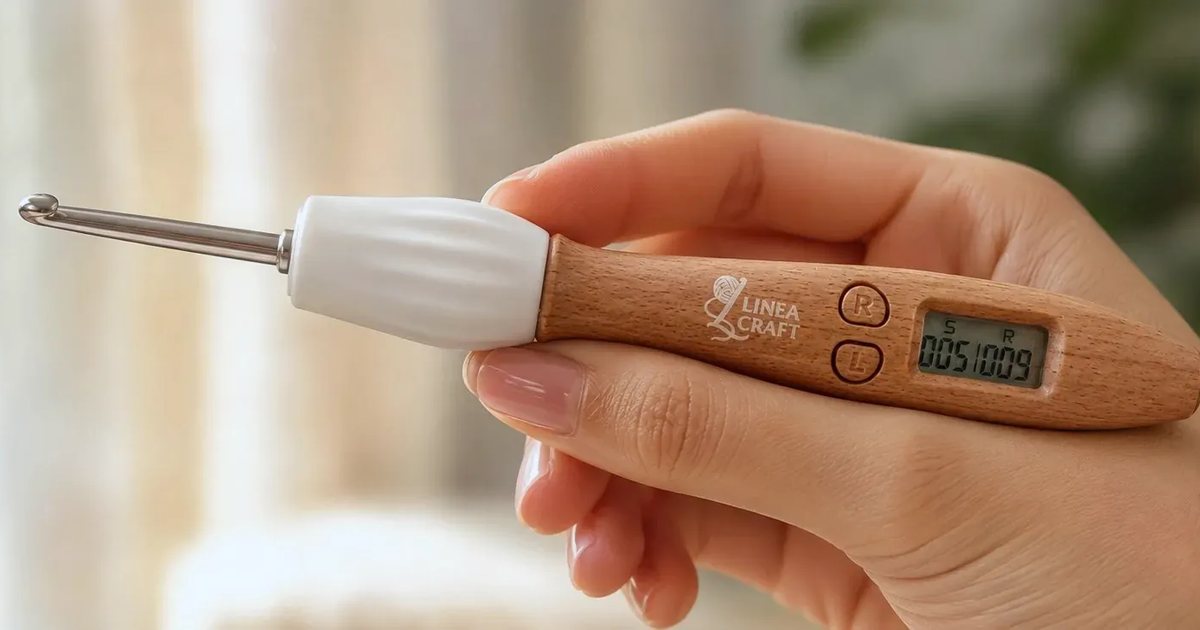
An ergonomic crochet hook has a handle shaped for your hand, usually thicker, softer or rounder than the thin shaft of a plain metal hook. Some shops call it an ergonomic crochet needle, and it’s the same tool.
We sell one, the LineaCraft Counting Crochet Hook Set ($59.99), so we have a stake in the answer. The advice below comes from occupational therapists, hook reviewers and a hook maker, linked where we use them. We couldn’t find any set standard for the word “ergonomic” on crochet hooks, so judge a hook by its handle and tip, whatever the label says.
How to choose an ergonomic crochet hook
- Start with your grip. If you hold the hook like a knife, look for a thick, built-up handle. If you hold it like a pencil, pay most attention to the part under your fingertips.
- Pick a surface you like. Soft rubber and silicone grip well, and wood and bamboo feel warmer than bare metal.
- Check the tip as well as the handle. A comfortable handle won’t help much if the head catches on your yarn.
- Check the sizes. Some soft-grip sets stop at 6 or 8 mm, so chunky yarn needs a set that goes higher.
- Hold it before you commit, if you can, or buy from a shop with easy returns. Comfort is personal.
If you also lose count, we’d pick our set: one rounded handle for all 18 sizes, with a stitch and row counter built in. The reasons are at the end of this post.
What makes a crochet hook ergonomic
A plain metal hook is a thin shaft with a small flat spot for your thumb, so your fingers close tightly around something narrow. An ergonomic handle gives them more to hold.
The same idea shows up in hand therapy. Shelia Tenny, an occupational therapist and certified hand therapist, writes that tools can be modified with enlarged handles to help avoid tight grips. Her advice covers tools in general, so it doesn’t vouch for any particular hook.
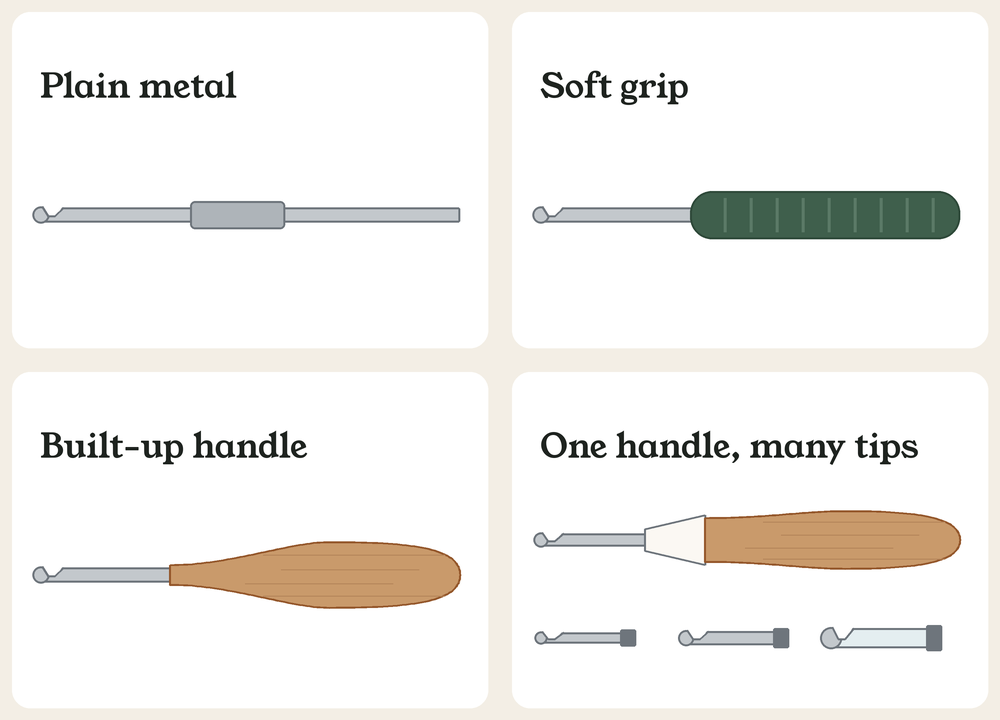
| Handle | What it is | Who it suits |
|---|---|---|
| Plain metal | A thin shaft with a small flat thumb rest | People who like a slim hook, and short projects |
| Soft grip | A rubber or silicone sleeve over the hook | Anyone who wants some cushion or a firmer hold |
| Built-up handle | A thick, rounded handle in wood, bamboo or resin | Knife-grip crocheters, and anyone who finds thin hooks hard to hold |
| One handle, many tips | A full-size handle with screw-on tips for each size | People who work in many sizes and want each one to feel the same |
Which handle suits your grip
Most crocheters naturally prefer one of two grips, and some switch between them depending on the project. In the pencil grip, you hold the hook the way you’d hold a pen. In the knife grip, your forefinger rests on top of the hook and the handle sits under your palm.
The knife grip puts the handle against your palm, so thickness matters most. PlanetJune’s hook review says of one slim hook that its narrow handle, especially in the smaller sizes, makes it less comfortable to hold, and that a built-up handle may feel more comfortable if you use a knife grip.
We found little published advice on handles for the pencil grip. You hold the hook with your fingertips and the rest of the handle sits above your hand, so the part under your fingers is what you’ll notice. Go by feel.
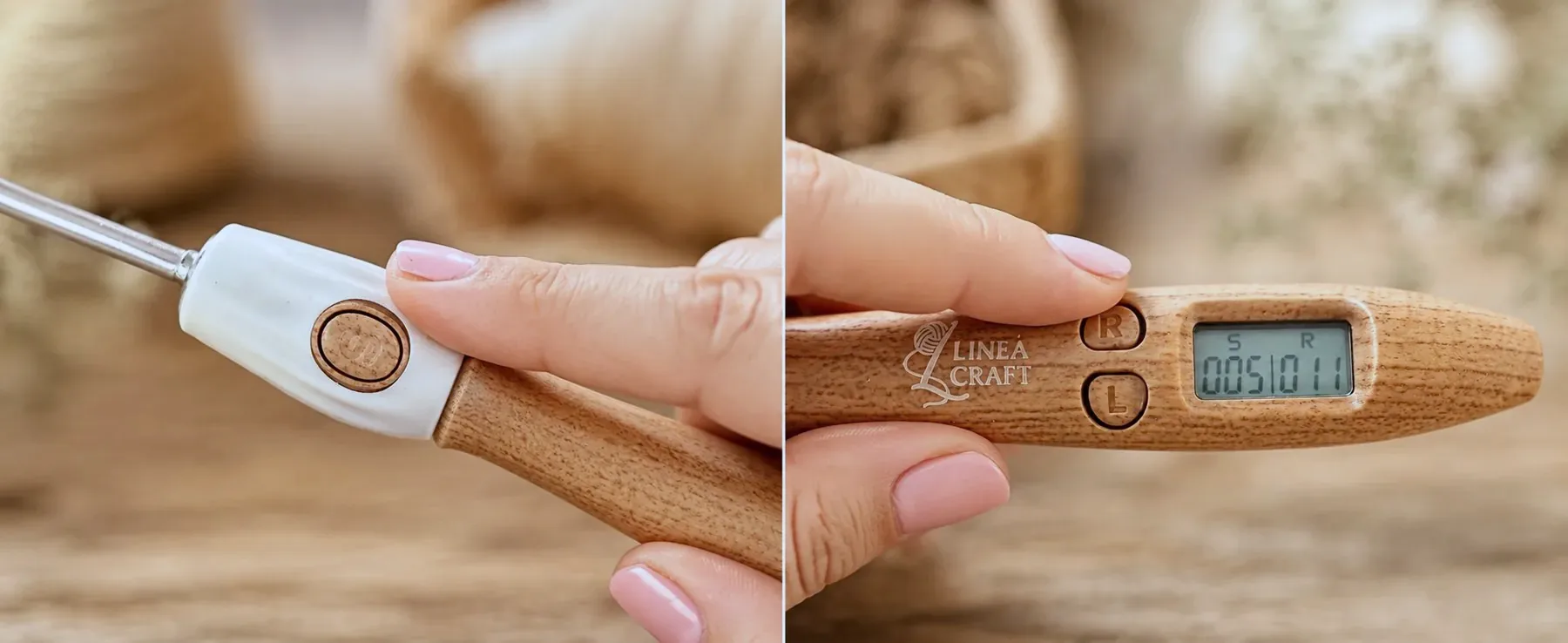
On a counting hook, also check that you can reach the buttons in your grip. On ours, the S button sits on the white collar next to the hook, under your fingertip, so you can keep crocheting while you count.
Handle materials compared
Rubber and silicone
These are the soft grips. The Arthritis Foundation’s needlework tips suggest trying hooks with rubberized grips, and hook maker KnitPro says a flexible silicone handle gives a firmer hold, which helps if your palms get sweaty.
Wood and bamboo
The Arthritis Foundation’s tips recommend birch or bamboo knitting needles because they’re lightweight and warmer to the touch than metal, and the same materials are used for hook handles. PlanetJune’s reviewer found a bamboo handle very comfortable to hold.
Wood-style finishes
A wood-grain finish gives you the look of wood on a lighter handle. Ours is one of these: it isn’t solid wood, which keeps the weight down, even with a counter and an LED for the clear tips inside.
Bare metal
Bare metal is slim and simple, but it has no cushion, and KnitPro notes that some people have sensory issues with its sound or feel.
The tip matters as much as the handle
Your hand touches the handle, but your yarn only touches the tip. Metal tips are usually the smoothest on yarn. Bamboo and wood have more drag, which some people like on slippery yarn.
Head shape is personal too. On an in-line hook, the head is about as wide as the shaft and lines up with it. On a tapered hook, the head is rounder and narrower than the shaft. PlanetJune’s June Gilbank calls the in-line shape the most important factor when she chooses a hook, and notes that people who prefer tapered hooks probably won’t enjoy in-line ones. KnitPro adds that a sharp throat angle suits hard, thin yarn and can catch on soft, loosely twisted yarn.
One handle or a set of separate hooks
A set of separate hooks gives every size its own handle, which suits people who leave a hook parked in each of several projects.
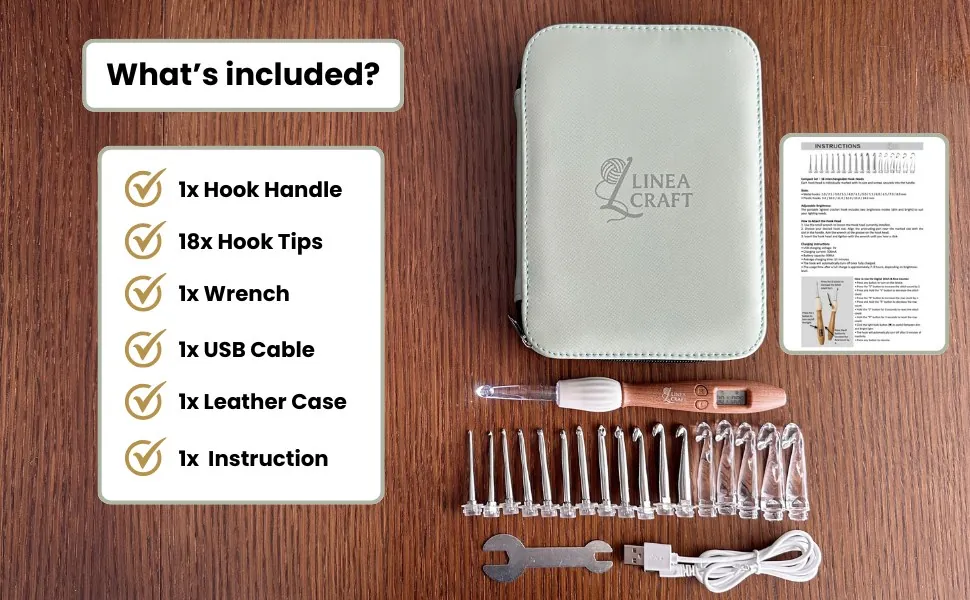
One handle with screw-on tips keeps the feel the same from the smallest size to the largest, and it packs small. Ours has 18 tips in one zippered case, and you tighten each tip onto the handle with the included wrench so it stays in place while you crochet.
Try a thicker handle before you buy
You can find out whether a thicker handle suits you with a hook you already own. The Arthritis Foundation’s tips suggest building up a hook’s handle with tape if standard hooks cause pain or pinching. Wrap some tape around the handle, crochet a few rows, then add or remove layers until it feels right. That’s roughly the thickness to look for when you shop.
If your hands hurt when you crochet
We sell hooks, so we won’t tell you one will ease pain or treat a condition. If crochet hurts, talk to a doctor or hand therapist, who can look at your hands and how you hold the hook. The Arthritis Foundation’s needlework tips, quoting two experts at the American Occupational Therapy Association, put it simply: pain is not normal, so try to avoid it.
Regular breaks are free. The same article suggests standing, walking or stretching for three to five minutes every 30 to 45 minutes. Shelia Tenny suggests stopping to stretch every 15 to 20 minutes during repetitive gripping work such as crochet.
Breaks are easier when you don’t lose your place. Our hook keeps its count when you switch it off, and our free online row counter saves your count in your browser.
Why we’d pick ours
- One rounded, ergonomic handle for all 18 sizes, from 2.0 to 14.0 mm, so the hook feels the same in your hand whatever yarn you’re using.
- A stitch and row counter in the handle that keeps both counts when you switch it off, so you can stop for a break mid-row and pick up where you left off.
- The stitch button sits under your fingertip. Of the 14 counting hook sets we checked on Amazon in October 2026, ours is the only one whose review summary lists button placement as a positive.
- Amazon’s review summary for our set also lists comfort as a positive, and one reviewer says the yarn glides on the metal tips without snagging.
- 12 metal tips from 2.0 to 8.0 mm, and 6 clear tips from 9.0 to 14.0 mm for chunky yarn. Only the clear tips light up.
It’s the LineaCraft Counting Crochet Hook Set, $59.99 with 30-day returns, so you can see how the handle feels in your own hand.
To match a tip to your yarn, see our crochet hook size chart. If you’re weighing up a hook with a counter, read do counting crochet hooks work.
Questions about ergonomic crochet hooks
What is an ergonomic crochet hook?
It’s a crochet hook with a handle shaped to be easier to hold, usually thicker, softer or rounder than a plain metal hook. Common types are soft rubber grips, built-up wood or resin handles, and single handles with screw-on tips. LineaCraft couldn’t find a set standard for the word, so check the handle itself.
Are ergonomic crochet hooks worth it?
They’re worth it if thin hooks feel hard to hold or you like a thicker, softer grip. To check before you buy, wrap tape around a hook you own until it’s thicker and crochet a few rows. If a slim hook already feels fine, you may not notice much difference.
Are ergonomic crochet hooks good for arthritis?
A hook isn’t a treatment, and LineaCraft can’t promise one will ease pain. The Arthritis Foundation’s needlework tips suggest trying hooks with rubberized grips, building up handles with tape if standard hooks cause pain or pinching, and taking regular breaks. A doctor or hand therapist can advise you on your own hands.
What is an ergonomic crochet needle?
It’s another name for an ergonomic crochet hook. Some shops call crochet hooks needles, but the tool has a hook at the end and no eye.
How do you hold an ergonomic crochet hook?
The same way you hold any crochet hook: like a pencil or like a knife. In the knife grip, the handle sits under your palm, so a thick handle fills your hand. In the pencil grip, you hold the hook with your fingertips and the handle sits above your hand. Use whichever feels more comfortable.
Which ergonomic crochet hook is best?
LineaCraft sells one, so this is a seller’s view. The right one depends on your grip and the sizes you use. Look for a handle thick enough that you don’t have to pinch it, a tip that moves smoothly on your yarn, and sizes that cover your projects. We’d pick the LineaCraft Counting Crochet Hook Set, which has one rounded handle for 18 sizes from 2.0 to 14.0 mm and a stitch and row counter built in.
Do ergonomic crochet hooks come in large sizes?
Yes, but some soft-grip sets stop at 6 or 8 mm, so check the size range before you buy if you use chunky yarn. The LineaCraft set goes up to 14.0 mm. LineaCraft’s crochet hook size chart shows which size suits each yarn weight.