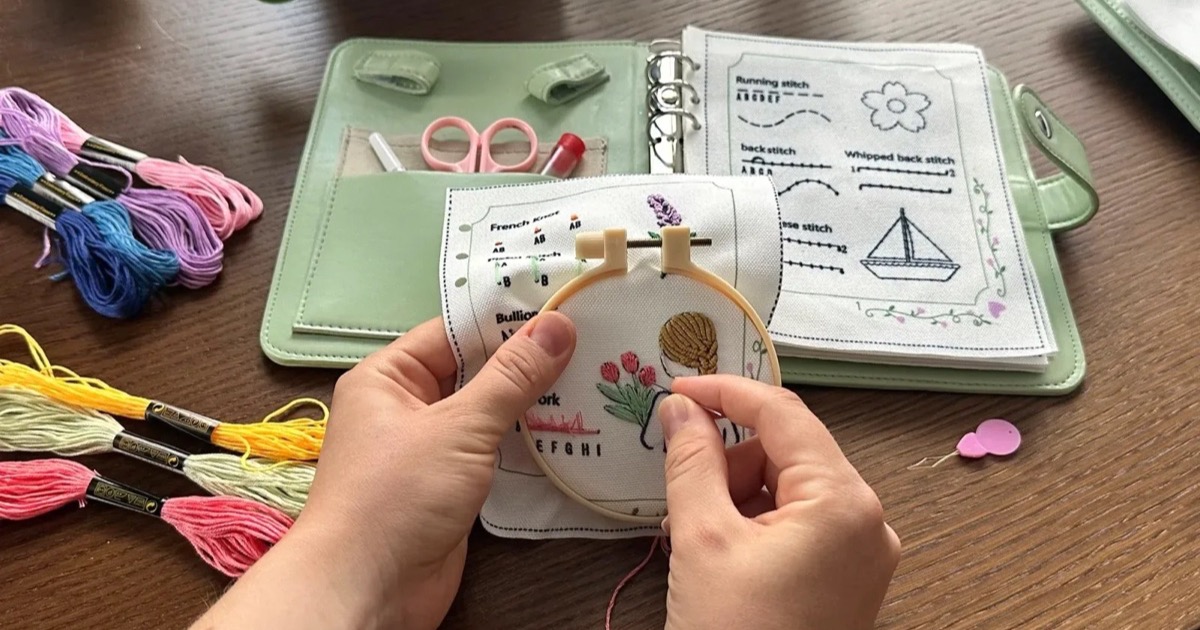
An embroidery stitch book is a hand embroidery kit bound like a book. Its pages are pieces of fabric with stitches and small designs already printed on them, and the cover holds the hoop, floss, needles and scissors you need to stitch them.
You work through it one page at a time. Each page teaches a few stitches, then gives you a small motif to practice them on. When you finish, the page goes back into the book, so the stitches you have learned stay together in one place, and you can flip back to any of them later.
It is an old way to learn. Diana, who founded LineaCraft, learned embroidery from her grandmother like this: learn the essential stitches, practice them on something small, and keep them close as a reference. A stitch book follows the same method.
What’s inside a stitch book kit
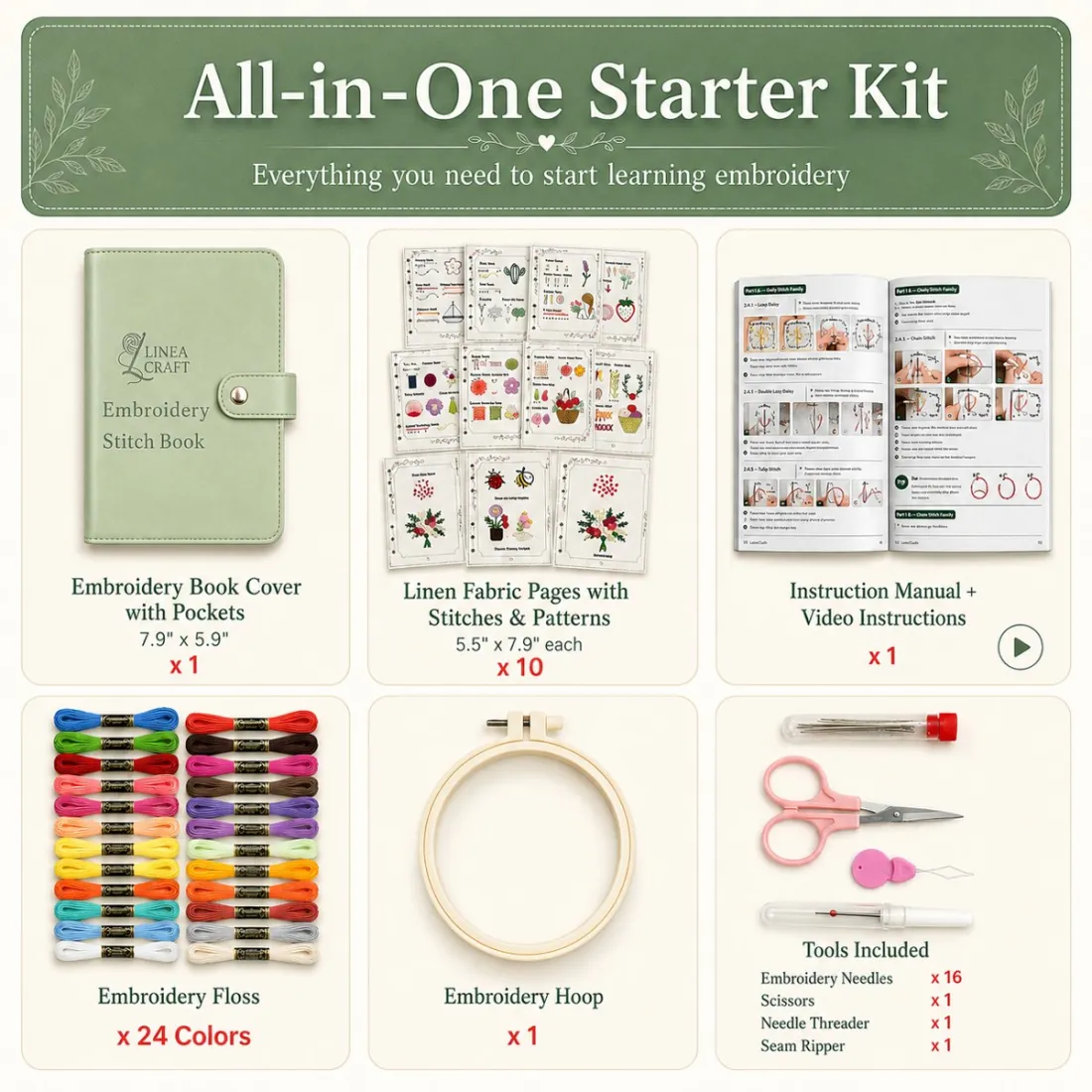
Kits differ, but most have three parts: the pages, the tools and the instructions. Pages are usually linen or cotton, printed with the outline of each stitch and a few small designs. The tools are the basics of hand embroidery: a hoop to hold the fabric tight, six-strand embroidery floss, needles and small scissors. Instructions come as a printed booklet, videos, or both.
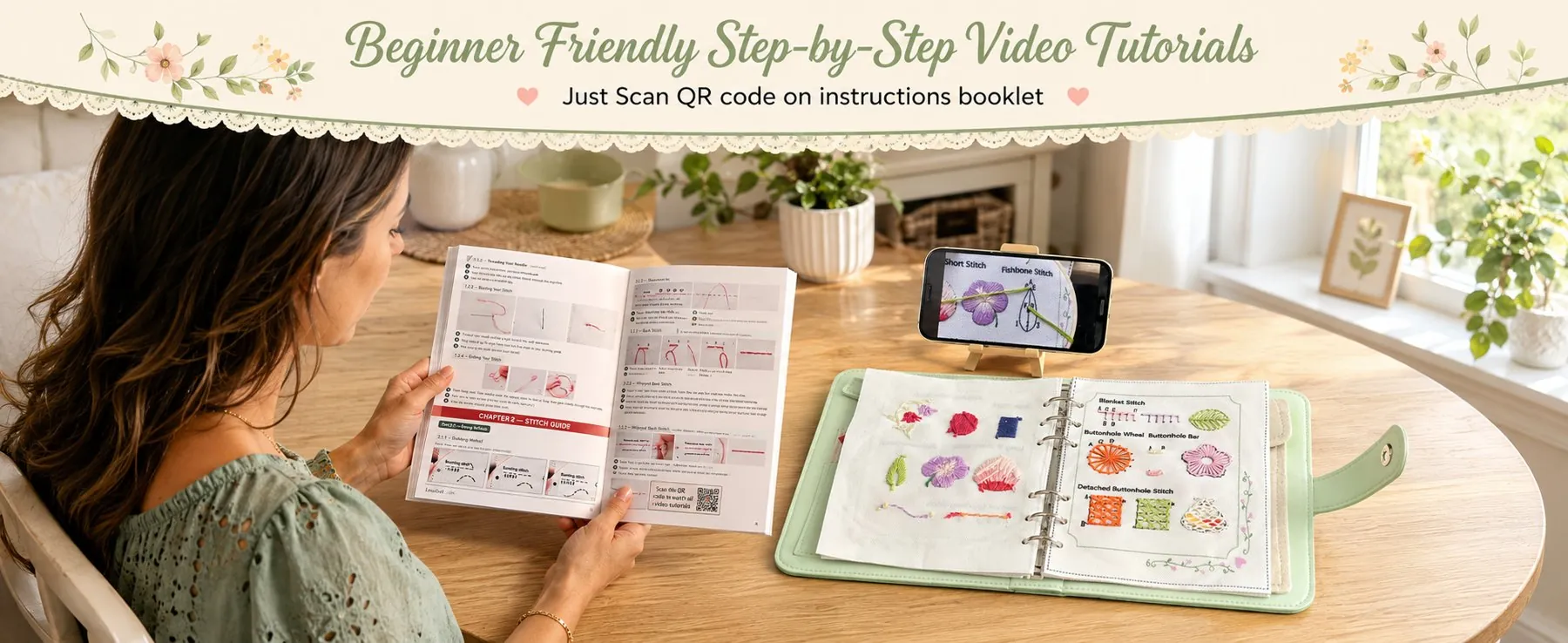
The LineaCraft Embroidery Stitch Book Kit has 10 removable linen pages, each 5.5 × 7.9 inches, printed with 33 stitches and 22 mini projects. The faux leather hardcover has loose-leaf rings for the pages and pockets for the tools. Inside are an embroidery hoop, 24 colors of six-strand floss, 16 needles, a needle threader, a seam ripper and embroidery scissors, plus a printed instruction booklet with a QR code that opens a step-by-step video for every stitch.
How a stitch book works
Every page goes through the same three steps.
- Lift out a page. The pages sit on loose-leaf rings, so any one of them comes out on its own.
- Hoop it and stitch along. Clip the page into the hoop, open the video for the stitch, and follow the printed lines.
- Slot it back in. Page by page, the book turns into a sampler of every stitch you have learned.
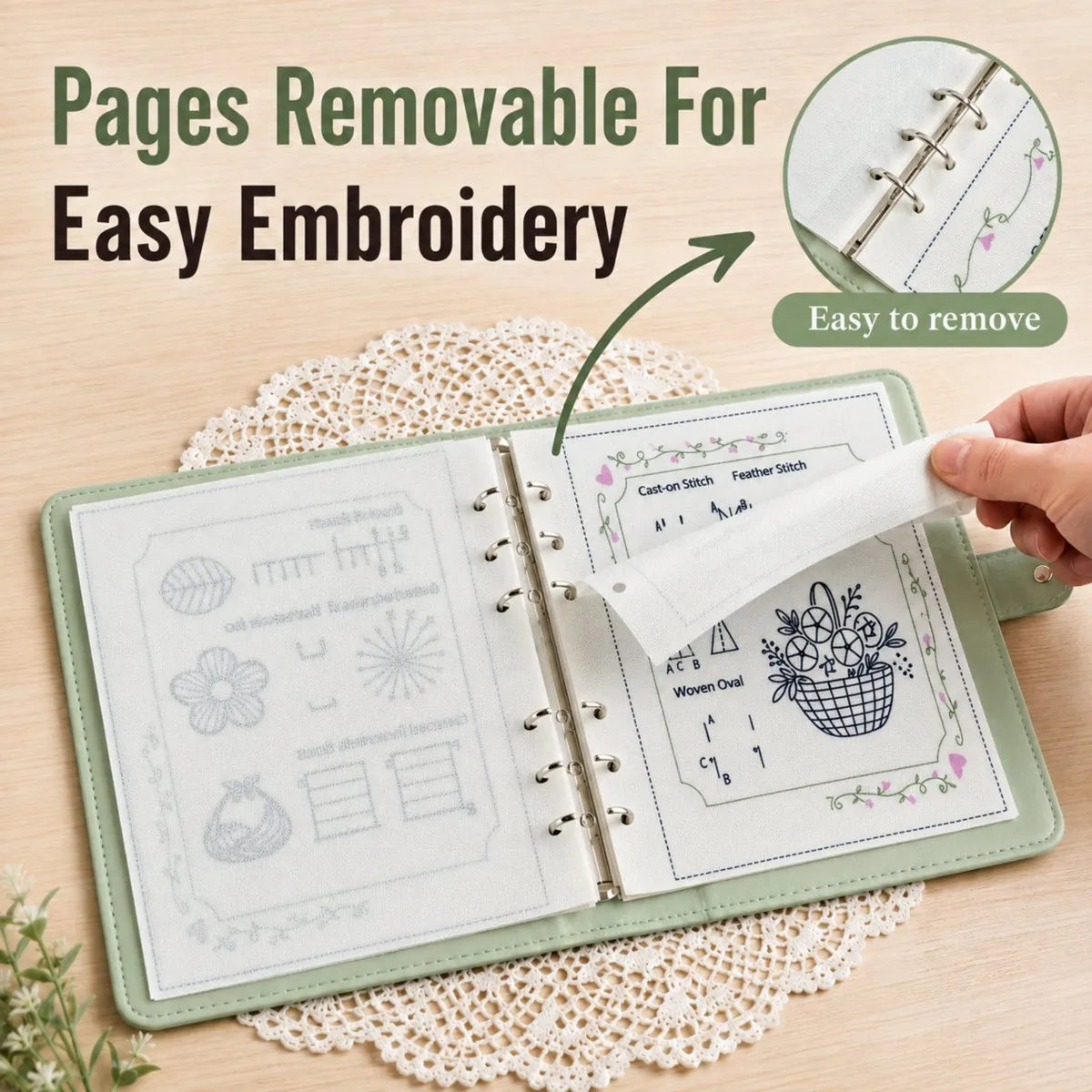
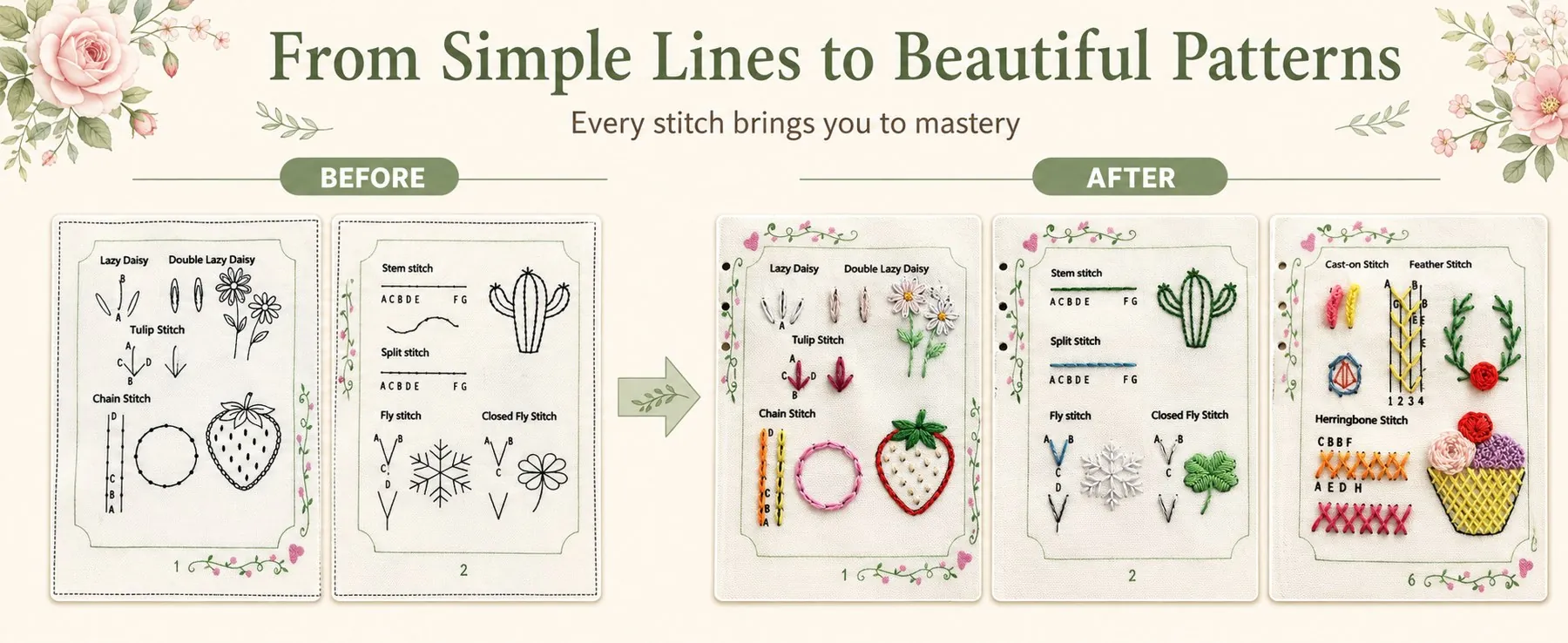
Because the designs are printed on the linen, you never have to trace or transfer a pattern. For many people that is the hardest part of starting embroidery: picking a transfer method, finding a pen that washes out, and lining the design up on the fabric. A printed page lets you skip all of it and start with the needle.
How a stitch book compares with other ways to learn hand embroidery
Most beginners choose between a stitch book and a kit for a single design. Here is how they differ.
| Stitch book kit | Single-design kit | |
|---|---|---|
| What you learn | A set of stitches, from easy to harder | The few stitches one design uses |
| Tracing a pattern | Not needed, the pages are printed | Usually printed |
| Tools | In the cover | Often included, sometimes not the hoop |
| What you keep | A book of every stitch you learned | One finished piece |
| Best for | Learning the stitches | Making one thing to hang or give |
A single-design kit is a good choice when you want one finished hoop for a wall. A stitch book suits you if you want to learn the stitches themselves, so that later you can stitch any design you like. Free videos with supplies bought one by one cost the least, but you have to choose every tool and trace every pattern yourself, which is a lot to work out before your first stitch.
Who a stitch book suits
A stitch book is made for people who have never embroidered, or who tried once and gave up because they didn’t know where to start. The stitches come in order, and each one has its own video, so you can watch it up close, pause and rewind as often as you need.
Anyone looking for a calm hobby without a screen will like it too. One page is a small, finished task for an evening. The book closes with everything inside it, so it travels well in a bag. Our kit is meant for adults and teens.
As a gift, it works for someone who has said they’d like to try embroidery. They can open it and start stitching the same day, with nothing else to buy, and the cover looks like a present before you wrap it.
Skip it if you want to start with a large piece, like a full hoop of flowers to frame. The mini projects are small on purpose. And if you were searching for machine embroidery, this is hand embroidery: a needle, floss and your hands, with no machine involved.
Tips for your first pages
- Watch the video for a stitch once before you pick up the needle, then play it again and stitch along.
- Embroidery floss is made of six thin strands twisted together. Pull out only as many as your instructions ask for. Fewer strands give a finer line.
- Cut the floss about as long as your forearm. Longer pieces tangle and wear thin before you use them up.
- Keep the fabric tight in the hoop, and tighten it again if it starts to sag.
- Don’t pull each stitch hard. The floss should lie flat on the fabric without bunching it up.
- Unpick a stitch you don’t like with the seam ripper and try it again.
- Take the page out of the hoop when you stop for the day, so the ring doesn’t leave a crease in the linen.
Expect your first page to look uneven. Even stitches come with practice, and by the later pages you can look back at the first ones and see how far you’ve come.
What to look for in a stitch book kit
Some book kits teach around 15 stitches, while others list more than 80. A bigger number isn’t automatically better. Check these points before you buy:
- The stitches go from easy to harder, and each page builds on the last.
- The designs are printed on the fabric, so there is nothing to trace.
- Every stitch has a video, so you can see how the needle moves.
- The hoop, floss, needles and scissors are all in the box.
- The pages come out, so you can hoop one at a time.
- The cover has room to store the tools, so nothing gets lost between sessions.
The LineaCraft Embroidery Stitch Book
We designed our stitch book to meet every point on that list. It has 33 stitches and 22 mini projects (flowers, fruit and little baskets) across 10 linen pages, a video for every stitch, and all the tools inside a faux leather cover.
Questions about stitch books
Is an embroidery stitch book good for complete beginners?
Yes. It starts with the simplest stitches and adds harder ones page by page, with a video and printed instructions for each. You don’t need to know anything before you start.
Do I need to trace or transfer the patterns?
No. Every stitch and design is printed on the linen pages, so you can unbox the kit and start stitching.
Do I need to buy anything else?
No. The hoop, floss, needles, threader, seam ripper and scissors all come in the kit. A good lamp helps, since small stitches are easier to see in bright light.
Can I stitch a page twice?
Each page keeps the stitches you made on it, which is what turns the book into your own reference. To practice a stitch again, put any plain cotton or linen in the hoop and copy it from the finished page.
What’s the difference between a stitch book and a stitch sampler?
A sampler is one piece of fabric covered in different stitches. A stitch book spreads them across removable pages, adds small projects to practice on, and keeps the tools in the cover.
Is this hand embroidery or machine embroidery?
Hand embroidery. You stitch with a needle and floss, and you don’t need a machine.